Thorny problems with Molinism #3: the theological grounding objection
Molinism removes the metaphysical machinery that underwrites God’s knowledge of free actions (i.e., his knowing what he will cause), but does not replace it with anything. Thus, middle knowledge is a just-so story; an assertion we are supposed to accept “because reasons.” Only…there are no reasons.
Continued from part 2, on how John 6:44 contradicts libertarian freedom
One of the most popular objections to Molinism is called the grounding objection. The Molinists I’ve spoken to seem to think this objection amounts to very little—possibly because they miss the major theological point of it. In fact, I think many disputants on both sides of the fence construe the issue to be:
In other words, what are the grounds of their truth? What makes it true, for instance, that Ali would choose X in some circumstance—given that Ali has not, does not, and will not actually exist in that circumstance?
I do think this grounding objection to the truth of CCFs is a problem for Molinism, but I don’t intend to discuss it in this series because it is not very accessible to lay Christians, requiring a decent grasp of modal logic and a specialized vocabulary. Some arguments, even though they are good, are too technical to warrant looking at outside of philosophy journals.
If we want to do theology forwards, rather than backwards, the much more fundamental question is not what grounds the truth of CCFs; it is what grounds God’s knowledge of them. How does he know that in some circumstance, Ali will do X rather than Y? In other words:
In the past, when I’ve raise the grounding objection, Molinists have pointed me to William Lane Craig’s response, William Lane Craig, “Middle Knowledge, Truth-Makers, and the ‘Grounding Objection’” (n.d.). https://web.archive.org/web/20170326074500/http://www.reasonablefaith.org:80/middle-knowledge-truth-makers-and-the-grounding-objection. Incidentally, notice in this article Plantinga‘s quoted comment that, It seems to me much clearer that some counterfactuals of freedom are at least possibly true than that the truth of propositions must, in general, be grounded in this way
—a fine example of the absurdly speculative way in which philosophers go about “deciding” the truth of something. as if it settles the matter. But this response is simply irrelevant to the theological grounding objection. It doesn’t address the grounding of God’s knowledge of CCFs at all, which is the real issue. So let’s talk about that.
The Molinist stipulates that God knows all truths. Therefore, he must know CCFs. QED, problem solved. There is a very sneaky sleight-of-hand going on here which slips under the anti-Molinist radar, because we all agree that God knows all truths. So it’s easy to miss that we have a fundamental difference of opinion here.
How God knows all truths according to the Bible
If you do theology forwards instead of backwards, you discover that God’s knowing all truths is not a bald assertion of scripture—something true “just because”—but rather a deduction from scripture, based on God’s relationship to the world. We find that God “upholds the world by the word of his power” (Heb 1:3)—that is, he does not merely cause it to exist initially and then let it run on its own like autonomous machinery. Rather, he causes it to exist moment to moment.
But it doesn’t make sense to say that God causes a goat, for example, to exist moment to moment—but then to deny that he causes it to exist in the way it does. If something exists at all, it exists in a certain way or in a certain state or with certain parts and properties. And of course, its way of existing will change moment to moment, with some parts or properties staying the same (the ones that are essential to what it is), and some changing (the ones that are accidental to what it is).
So for example, at a moment of time the goat will exist in the way of being a goat (because that is its essential nature); and also in the way of eating the washing (because this is an accidental property of its being a goat). But then at a later moment of time, the goat will still exist in the way of being a goat, but also perhaps in the way of not eating the washing, instead standing in a tree (another accident of being a goat, at least in a tree-filled environment).
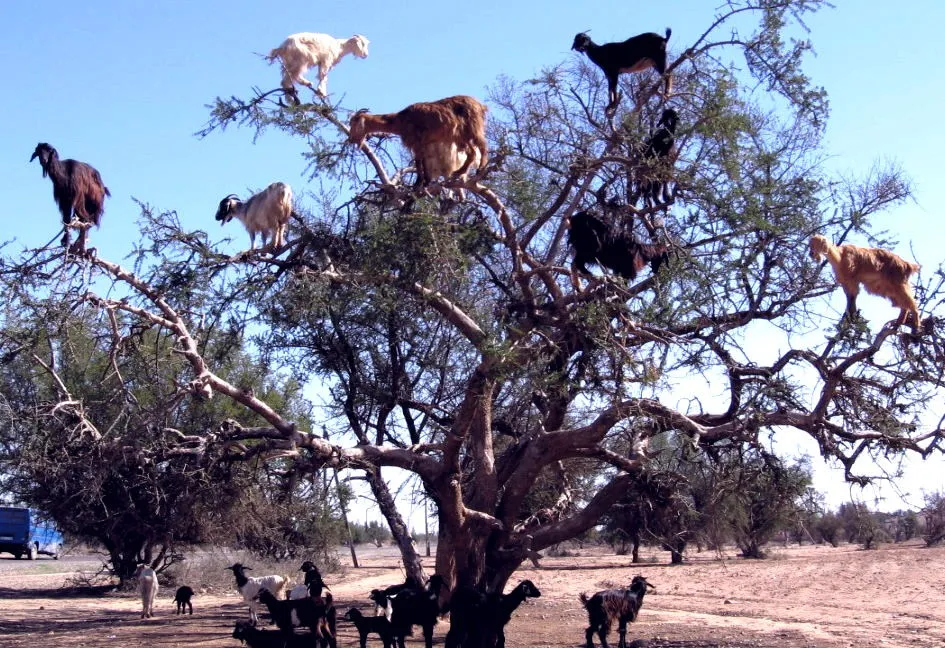
People, like goats, have essences and accidents, and the choices we make are among those accidents. But the natural implication then is that, if God causes the total existence of our friend Ali moment to moment, then surely he causes both the existence of her essence and her accidents—so he not only causes who she is but also what she does.
Put more simply, everything about creation, including human decisions, is ultimately caused by God. And this is certainly the straightforward meaning of many of the passages I mentioned in the previous post. What we find in scripture is an exhaustive sovereignty wherein God continually keeps everything in existence to the nth degree.
This view of God’s causal relationship to the world is important because it is the basis of his knowledge: God knows all truths about creation because he knows what he has chosen to cause in creation. But of course, God does not merely know what he has chosen to do; he also knows what he could choose to do. He knows all the things he could cause in creation, or would cause in creation, given different circumstances.
Now, please note that even if you don’t accept my reasoning here, or you want to interpret the passages I’ve given differently, what I’m presenting is clearly a plausible account for grounding God’s knowledge of creation—and especially his knowledge of what people would do in other circumstances (CCFs):
How God knows all truths according to Molinism
Now notice the Molinist’s sleight of hand: he disagrees that God has this kind of causal relationship with our choices. If he did, his knowledge of CCFs would fall under his natural knowledge rather than his middle knowledge—in which case (i) we could not choose other than we do (violating the principle of alternate possibility), and (ii) our choices would ultimately originate in God (violating the sourcehood constraint). The Molinist intuits that this would make our choices not free, and God would then be the author of sin; hence we need middle knowledge.
So here’s what he does: he removes the theological underpinnings to God’s omniscience. He says, “No, God does not have that kind of causal relationship with us. CCFs are not part of his natural knowledge.”
But does he then commensurately discard the standard doctrine of omniscience? Not at all! He continues to help himself to omniscience, as if God’s knowledge of the world were independent of his relationship to it. And since no one calls him on his little charade, he thinks nothing is the matter, calls this new invention “middle knowledge,” and skips merrily on his way.
This simply won’t do.
You aren’t entitled to say God “just knows” counterfactuals of creaturely freedom because he knows all truths, after you have removed the means by which he comes to know all truths in the first place! If you cut the link between God and these kinds of truths, and you fail to replace it with anything that does the same work, you don’t get to keep pretending the link exists.
Another way to put this is as follows: knowledge involves more than just true belief. To know something is to believe it for the right reasons. One must be justified in believing it, rather than having a merely coincidentally correct belief. But what justification is there for God to believe that Ali would do X in some circumstance?
- It cannot be that he “observes” her doing it, since it never actually happens.
- It cannot be that he knows it because it must be true, since the whole point of CCFs is that Ali is free to choose Y also, and she would hardly be free if it must be true she will choose X.
- And it cannot be that he knows it because he would cause it, since the Molinist denies that God has that kind of causal relationship with people.
So this thorny problem must be pressed against the Molinist: how does God glom onto the truth of CCFs? How are they accessible to him?
Molinists—as far as I can tell—have nothing but a just-so story to replace the weighty metaphysical machinery that other Christians rely on for explaining God’s omniscience. But an assertion is no substitute for an argument. Why should anyone not already dogmatically committed to Molinism accept a wink and a nod in place of a plausible contrary explanation? Middle knowledge, on this point, seems to be nothing but an errant fraud; smoke and mirrors concealing nothing.
Continued in part 4, on the contradiction between CCFs and PAP
Has my work helped you?
Buy me a coffee