What if the Bible depicts a solid domed sky and a flat earth held up by pillars?
What would this tell us about the Hebrew worldview, and about inerrancy?
I respect the opinion of Michael Heiser as a Semitic scholar. So I recently asked him what he thought of Randall Younker and Richard Davidson’s argument that the Hebrew word raqiya, often translated “firmament,” does not imply a solid vault or dome Randall W. Younker and Richard M. Davidson, “The Myth of the Solid Heavenly Dome: Another Look at the Hebrew רָקִיעַ; (rāqîa‘),” Andrews University Seminary Studies 1: 125–147. https://drive.google.com/file/d/0B1SNBwRLz9kAaVlhRks2bmMwWkx5bGFuUWtpRUNzMG9TSC1R/. —and that this view was actually introduced in the early 19th century by skeptics Washington Irving and Antoine-Jean Letronne. Younker and Davidson document how Irving and Letronne simply invented the myth that ancient peoples believed the earth was flat, and argue that this fabrication, in conjunction with a questionably wooden reading of Scripture, became the mistaken basis for the Hebrew cosmography shown in the image below.
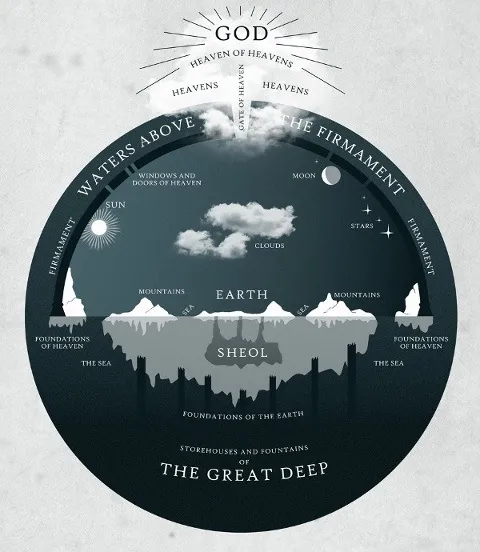 Suffice to say Michael was not persuaded. I’ll not assess his reasons here; I’m far less convinced than he is, but that is a topic for another article. What I’d like to do here is actually assume for the sake of argument that the “standard” view is correct: the Bible really does depict a cosmography more or less as represented in this diagram.
On the face of it, this seems to put inerrancy in serious jeopardy. See Dominic Bnonn Tennant, “Inerrancy without the weasels” (April 2014). https://www.bnonn.com/inerrancy-without-the-weasels.
But I have a question:
This might seem like a really odd question—even a stupid one. If the Bible depicts the world in this way, then obviously that is because the Hebrews believed the world was constructed this way…right? Why would they depict the world in this way if they didn’t believe it? Or why would they disbelieve it if the Bible depicted it?
Well, let me ask you another question: do you think the Egyptians believed they lived on the surface of a god named Geb who was lying beneath another god, Nut, who was held up by a third god, Shu—and that when they looked up at the sky, what they were seeing was actually Nut’s exposed breasts and midriff, along with of course Re, the sun-god? As you can see in the photograph, that is how the Egyptians depicted their cosmography.
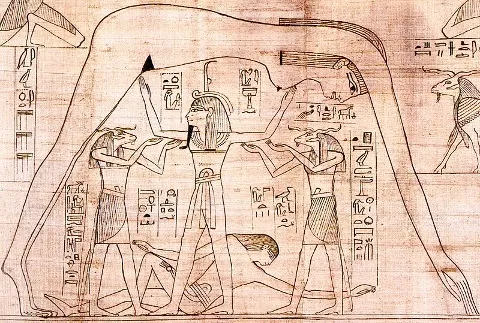
Some people look at pictures like these and think, “How on earth could anyone believe that?”
But it seems to me the real question is, “How on earth could anyone believe that anyone believed that?”
In other words, the issue is not with what the Egyptians and other ancient peoples believed, but with what we believe they believed. It strikes me as prima facie absurd to think that anyone in the ancient world took these images as depicting something physically true.
I mean, there’s unscientific thinking, there’s superstitious thinking, and then there’s just plain stupid thinking. For us to suppose that cosmographies like these were understood by their creators as physically literal depictions of the world is surely for us to engage in intense chronological snobbery. Would we prefer to imagine these people were absolute dunces—in which case, maybe we should try building a pyramid to disabuse ourselves—rather than to allow that perhaps their cosmographical descriptions were meant to depict something other than physical reality?
Which is more plausible: that ancient peoples believed things their own eyes could readily confirm was complete fiction…or that we have misunderstood them?
Some questions about Hebrew cosmography in this vein
- Did no one ever think to ask what the pillars holding up the earth were sitting on? Was it pillars all the way down?
- Did the Hebrews, en masse, really think that rain came out of doors in a solid sky, rather than out of clouds? Did no one make the connection in a culture where understanding weather conditions could often mean the difference between life and death? And did they not have any idea how water behaves when poured through an opening?
- Is it possible that when one Hebrew said to another, “Behold, the fountains of the great deep have been opened,” it was more like when we say to one another, “Wow, it’s raining cats and dogs” than when scientists tell us, “Evacuate! A vast underground reservoir has ruptured onto the earth”?
- If the sky was made of beaten metal, is it likely that no one ever questioned the fact that it was blue, and did not reflect the sun?
- If the Hebrews simply inherited the idea of a flat earth from other cultures, many of which were sea-faring, why did those cultures never figure out the reason that ships disappear over the horizon starting from the tops of their masts? It seems inconceivable that sailors would not quickly realize the earth was not flat.
These sorts of questions point to how implausible it is that FESS cosmographies were taken in straightforwardly literal terms. Now, this doesn’t tell us how they were taken, but it should give us pause about presenting the Hebrews as people with bizarre geographical and cosmological beliefs.
Has my work helped you?
Buy me a coffee