I oppose marital corporal punishment
Years ago, I assessed what the Bible says about marital corporal punishment. Contrary to wise counsel, I did some of my thinking out loud among my enemies. Now, screenshots of my comments are used to perpetuate a rumor that I support wife-beating. This is false, and always has been.
In late 2018–early 2019, I considered the question of whether biblical corporal punishment—which is not intrinsically abusive or wicked—can extend to marriage.
Why would I do this? I had no desire to use corporal punishment in my own marriage, and never have; neither do I support or condone it in any marriage—the idea disgusts me.
There were two factors in play:
Firstly, I have a mind that is often incapable of accepting things at face value. When tempered by wisdom, this drives me to seek deeper answers and clearer perspectives, which is largely what makes my ministry of any unique value at all. It is why, for instance, I have argued repeatedly that believing our moral intuitions without testing them produces every false religion, E.g., in my series on thorny problems with Molinism: https://bnonn.com/thorny-problems-with-molinism-1. and how I was able to tease out the kingdom theology articulated in The Spine of Scripture. But like all blessings, it comes with a downside: when not reigned in by righteousness, it leads me to treat rules as challenges, to speak impulsively, and to be what can only be a described as a bit of an edge-lord.
Secondly, at the time, I was on the tail end of a “red pill cage stage:” a difficult adjustment period in which I had discovered that many of my deep-seated assumptions and beliefs about sexuality and society were false—and that many people I had trusted on this topic at best were upholding harmful falsehoods, and at worst were disgusting enablers of a Satanic lie.
During most of this time I had been on a very negative trajectory, processing a great deal of cognitive dissonance, anger, frustration, and resentment. My now co-author, Michael Foster, had kindly helped me onto a positive path by the end, but there was still much residual emotion and doctrine to work through and repent of. This led me to question essentially every aspect of our received wisdom regarding the obligations and relationships of men and women—including, as it happened, whether corporal punishment was biblically permissible within marriage. Again, this was not a practical question for me, but a principled one. I was testing my assumptions because I no longer trusted my intuitions on pretty much anything relating to sexuality. The only thing I completely trusted was God’s word, and so that is where I sought the answer to this question.
I do not regret doing this; it was a necessary part of re-sinking the foundations of the theology of gendered piety.
While I was still testing the theological principles behind marital corporal punishment, I got embroiled in an anti-patriarchy Facebook group. My comments there were immediately immortalized by the power of the screenshot, and doomed to be reposted for years to come—perhaps even after my death.
One remark in particular has been widely shared. What you probably have not seen, however, is its full context:–

Please note that, contrary to what you are likely to hear from talebearers online, I never made an argument for marital corporal punishment; I tested one possible argument using Scripture’s own hermeneutic, the analogy of faith. Cf. my article on discerning the shape of Scripture: Dominic Bnonn Tennant, “Got a verse for that?”. https://www.discipleshipdominion.com/p/got-a-verse-for-that. I was submitting my intuitions to Scripture—the very thing these women refuse to do—testing how far the analogy of faith could be applied in this instance, while also affirming the rigid boundaries placed on physical discipline in God’s law.
I have left in the screenshot those comments which were made after I stopped interacting in that thread, including one from Nicole Parker who, despite our enmity, makes a good point about the reason that people (especially men) become atheists. However, to understand the theological level at which many of these women are operating, you may find it instructive to consider this short thread from further down on the same post:
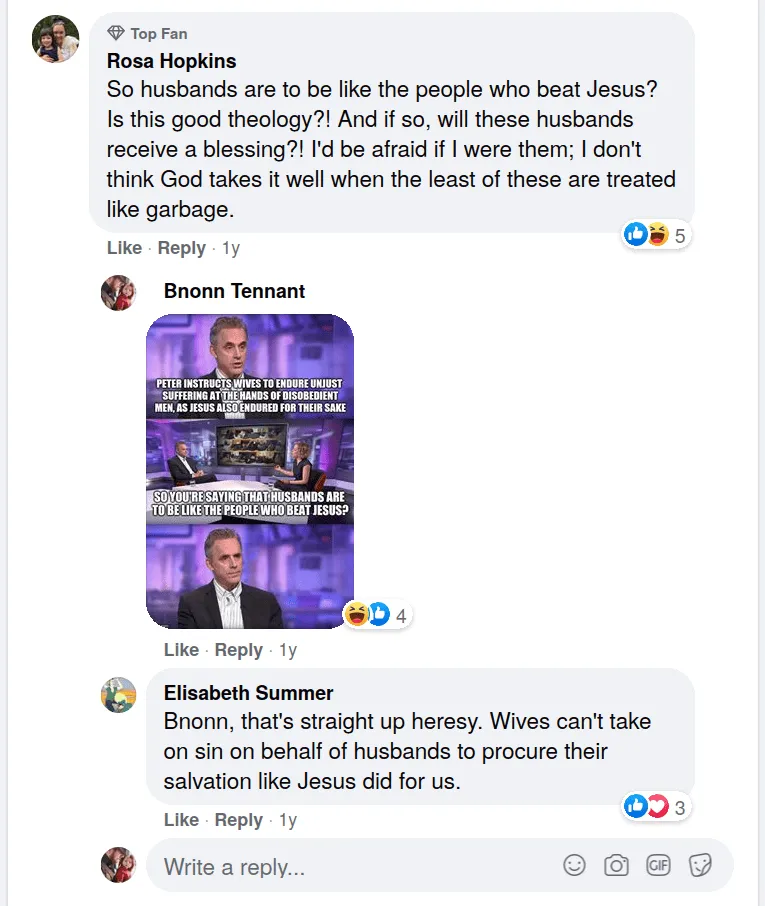
Please also note two obvious lies in the unstated assumption that anyone willing to entertain the question of corporal punishment in marriage must himself either be a “wife-beater,” or supportive of it:
- The first lie is a form of poisoning the well: the term “beating” is not understood in our culture to refer to a biblical exercise of physical discipline; something measured and loving rather than violent and hateful. If you hear of a “wife-beater” you imagine a man who rages out when drunk and puts his wife’s life at risk, which is utterly antithetical to what biblical corporal punishment looks like. Even though I repudiate corporal punishment in marriage, referring to that position as “wife-beating” is identical in principle to referring to corporal punishment of children as “child-beating.”
- The second lie is that the only reason to even consider certain views is to justify them. This is the snowflake mentality that says we don’t need arguments against evil—we just need to screech loudly until it slinks away. But on the contrary, Scripture says that the only weapon we have against the schemes of the devil are arguments from Scripture! (2 Cor. 10:4–5) How can we make such arguments if we do not work them out? By the same token, there is a plain and categorical difference between assessing the permissibility of a thing, and wanting to approve or endorse that thing. Feeling that something is wrong is not the same as knowing good from evil. Eve felt that the tree was good for food and desirable to make her wise. But the knowledge of good and evil, rightly acquired, takes training and searching out (Heb. 5:14; Pr. 25:2).
Where I stand in black and white
If you have heard tell to the effect that I am a wife-beater, or support wife-beating—or even if you have heard this couched in the less slanderous language that I affirm marital corporal punishment—you have been misled.
- I believe that a man who physically disciplines his wife is breaking the sixth commandment.
- I believe that a woman who is being physically disciplined by her husband has warrant from Scripture to appeal to the church and the state for justice. They are obliged to investigate the matter, to protect her, and to punish him on the evidence of two or three witnesses. (A fortiori, the same is true of any woman or man being physically hurt by their spouse in other ways.)
- I believe that anyone who suffers wrongfully because of subjection has warrant from Scripture to endure that suffering for the sake of the person over them, and is commended for imitating the Lord Jesus in doing so. This includes wives, as clearly stated in 1 Peter 2–3. (My considered view here in regards to divorce is the same as that of the PCA’s position paper, cited in William Smith’s helpful article Putting Asunder what God Joined: The Divorce Dilemma.)
You may also be interested to know that the primary catalyst for this rejection was not Facebook discussions with feminists, but face-to-face discussion with other men in the so-called neo-patriarchal movement, who graciously, thoughtfully, and firmly reasoned through the Trinitarian implications with me. Contrary to what anti-patriarchalists will tell you about the inherently abusive nature of these kinds of men, they were concerned that I should come to the right conclusion for the right reasons, that I would not bring shame and disrepute on myself—or, more importantly, on the Lord Jesus.
Sadly, some of that damage was already done. I am sorry for my part in it, and I have repented of it. The Lord Jesus is gracious to forgive my sins and cleanse me of all unrighteousness. Unfortunately my enemies are not so kind (cf. Gal. 5:15). If anyone whips out screenshots to show that I’m an apologist for wife-beating, they are bearing false witness. Ask them why.
Has my work helped you?
Buy me a coffee