Head coverings #1: the logic of glory and veiling
Friday, August 23, 2019
While head covering debates get mired in disagreement about cultural customs and what Paul meant about the angels, they ignore the central logic of 1 Corinthians 11—that only one glory should be on display in worship. Veiling still matters in the modern day because God’s glory still matters in worship—and that is what is at stake.
For nearly two years I have been chipping away at an article on head coverings, which inevitably became a series, and is now looking steadily more like a book. As I delved deeper and greedilier, the nature of the command as one for the whole congregation, across time and space, became transparent. But pinpointing where to start in explaining this proved a vexation, because all the pieces fit together in self-reinforcing ways.
This is still a problem I will have to overcome in the next part of this series, but thanks to Bill Mouser, Willam Mouser, “Hair and Worship” (February 2007). https://web.archive.org/web/20150715060616/http://fiveaspects.net/hair-and-worship/. Bill is also the author of the excellent The Story of Sex in Scripture. I can at least cut through the web of ideas by focusing on what Paul’s central argument actually is. Nearly no one—myself included—seems to pick up on it, though it is startlingly obvious once pointed out.
Paul’s central argument for veiling
Paul’s concern about head coverings derives from straightforward inferences about the nature of glory stated in verses 7 and 15 of 1 Corinthians 11:
4 Every man who has something on his head while praying or prophesying disgraces his head. 5 But every woman who has her head uncovered while praying or prophesying disgraces her head, for she is one and the same as the woman whose head is shaved. 6 For if a woman does not cover her head, let her also have her hair cut off; but if it is disgraceful for a woman to have her hair cut off or her head shaved, let her cover her head. 7 For a man ought not to have his head covered, since he is the image and glory of God; but the woman is the glory of man… 14 Does not even nature itself teach you that if a man has long hair, it is a dishonor to him, 15 but if a woman has long hair, it is a glory to her? 1 Corinthians 11:4–7, 14–15
Notice that Paul lists three different glories: God’s, man’s, woman’s. Presumably he took as obvious the implications of all these glories being simultaneously present in worship. The inference about why it is disgraceful for a woman to pray uncovered, and vice versa for a man, didn’t bear spelling out for him—but it unfortunately does for us, because we have inattentive, tin ears. So here it is, chopped into small enough pieces for us to chew:
Premise 1: There are three glories present in worship;
Premise 2: It is scandalous for a glory other than God’s to be shown off in worship;
Conclusion: Therefore, the other two glories must be covered.
We could end here and have an airtight argument for veiling, but it might not be very helpful since there’s a lot to understand. So let’s work through each premise in turn.
Premise 1: There are three glories present in worship
As plainly stated in verses 7 and 15, the glories are as follows:
- The glory of God (namely man)
- The glory of man (namely woman)
- The glory of woman (namely her long hair)
What does this mean? Before I answer, please observe something (I have nothing up my sleeve):
In other words, even if we could not explain what it means that man is the glory of God, and woman is the glory of man—a shockingly offensive-sounding statement to modern ears, after all—and a woman’s long hair is her glory—almost as offensive in a world where we dare not deny the cuteness of pixies and bobs for dread of the nearest Karen—even if we had not the slightest clue what all this meant, we would still have to accept on faith that Paul did, and that he stated it in order for us to believe it.
His statement is obviously not culturally-relative. What would it mean that man was the glory of God in ancient Corinth, but no longer today? No, these are creational statements, describing matters of fact about the design of mankind—not matters of fashion in first century Roman society.
This should be obvious from the get-go, but it becomes even clearer when we examine how Scripture uses this kind of language elsewhere.
What it means to be “the glory” of a thing
Glory, to use the language of my children, is that which is most majestical or splendifurious about a thing (cf. Psalm 21:5). It is what we think of when we ask what is great about it. It is the thing deserving greatest honor (cf. 1 Peter 3:7; 1 Corinthians 12:24). When the Old Testament authors considered God, for instance, one thing that was especially great about him was his strength and supernatural power (e.g., Exodus 14:17; 16:7; 1 Chronicles 16:24; Psalm 19:1; 29:1, 9 etc).
What does it mean for something to be the glory of a person, though? A representative example appears in Proverbs:
The glory of young men is their strength,
but the splendor of old men is their gray hair. Proverbs 20:29
Here, two glories are “rhymed.” What is especially great about young men, especially noteworthy, especially worth celebrating, is their strength. Conversely, with old men, it is their gray hair—a physical image of wisdom and a life well lived, to rhyme with the physical strength of young men (cf. Proverbs 16:31).
Scripture contains many such examples; here are some others:
- The glory of pastures are their flowers (Psalm 37:20; Matthew 6:28–30; James 1:10–11)
- The glory of a house is wealth (Psalm 49:16)
- The glory of rulers is the number of their people, and their ability to search out hidden wisdom (Proverbs 14:28; 25:2)
This last point illustrates that a thing can have more than one glory; it is no contradiction to say “the glory” without meaning “the only glory.” Despite the Old Testament describing God’s glory frequently in terms of might, that is not the only glory he has. According to 1 Corinthians 11:7, one of his important glories on earth is man. Which makes good sense, because his glory in heaven is a man as well:
Above the expanse that was over their heads was the likeness of a throne, as the appearance of a sapphire stone; and on the likeness of the throne was a likeness as the appearance of a man on it above. I saw as it were glowing metal, as the appearance of fire within it all around, from the appearance of his waist and upward; and from the appearance of his waist and downward I saw as it were the appearance of fire, and there was brightness around him… This was the appearance of the likeness of the glory of Yahweh. Ezekiel 1:26–28; cf. Ezek. 3:23; 8:4; 9:3; 10:18; 11:23; 43:2; 1 Corinthians 15:40; Hebrews 1:3
Why is man the glory of God? Because man is made as his image—to directly represent and serve God. See D. Bnonn Tennant, “What is the kingdom of God? Part 1: representation and rulership” (January 2017). https://bnonn.com/what-is-the-kingdom-of-god-1/. Paul himself describes this glory in terms of created origin and purpose, as is clear if you follow his explanations (indicated by the word for):
7 For a man ought not to have his head covered, since he is the image and glory of God; but the woman is the glory of man. 8 For man does not originate from woman, but woman from man; 9 for indeed man was not created for the woman’s sake, but woman for the man’s sake.
For Paul, glory, origin, purpose, and authority are bound up with each other. While many things can be a glory, he has in mind the glory which is tied up with honor and hierarchy (1 Corinthians 11:3–5, 10). He knows that it is glorious to rightly represent the one for whom you were made—to fittingly serve him—and he is concerned to preserve this glory in worship, ensuring its correct place in the hierarchy.
In other words, while woman originates from man and is made for man’s sake—and hence is man’s glory—man in turn originates from God and is made for God’s sake—and hence is God’s glory. Indeed, the man Jesus is “the radiance of his glory” and “the exact representation of his nature” (Hebrews 1:3), into whose likeness we are all being conformed (Romans 8:29; Philippians 3:21; 1 Corinthians 15:49; Colossians 3:10; 1 John 3:2). When we think of God, especially with respect to his rulership of the earth, the thing which we naturally celebrate, the thing most worthy of honor, is his image—man.
Why, then, is woman the glory of man? Is she not made in the image of God? Any modern Christian who claims not to get at least uneasy reading this passage—and probably tight under the collar—is fibbing. We are so conditioned by feminism we can’t help it.
But Paul does not say that woman is the image of man; he says that she is the glory of man. He distinguishes image and glory—they are related; not identical. Man is the image and glory of God; woman is the glory of man. He does not say “image and glory.” There is a sense in which she is the image of man—since she was made from man (cf. Genesis 5:3)—yet Genesis clearly ascribes God’s image to her also. D. Bnonn Tennant, “Are women made in the image of God?” (October 2018). https://bnonn.com/are-women-made-in-the-image-of-god/. She is a subordinate image, being made for the man, rather than for God. Man, being made to reflect and serve God, is God’s glory; woman, being made to reflect and serve man, is man’s glory.
Leaving aside biblical theology for simple embodied experience, we all know that women are the glory of men. They are the thing that, when considering humanity as a whole, men themselves are most inclined to celebrate. If presented with the choice of saving either a man or a woman, we save the woman; we consider them of greater value. One woman’s face launched a thousand ships. Another’s is compared to a summer’s day. Just as the beauty of the lily is the glory of the pasture, so is the beauty of the woman the glory of the man.
What, then, of the long hair? Again, this is self-explanatory. We don’t call them beauty parlors for nothing. The cliché of models in commercials swinging their heads in slow motion to display their—dare I say it—glorious locks is no mere coincidence. And this is not a statistical aberration:
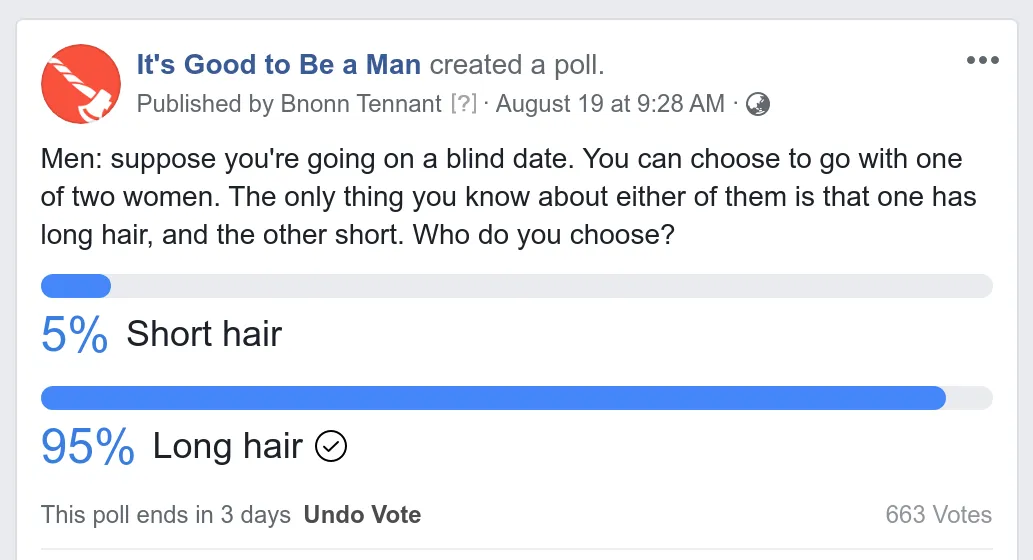
Of course a woman’s long hair is her glory. And of course that hair is the emblematic thing to be defaced by feminists seeking to reject the beauty of femininity. What is the reason that the stereotypical feminist not only cuts her hair short, but goes to the trouble of making it an unnatural color? It is because she understands, as we all do on some level, that comportment is a kind of communication D. Bnonn Tennant, “Comportment is communication” (January 2019). https://itsgoodtobeaman.com/comportment-is-communication/. (hence the term “body language”). Feminists have much they wish to communicate about their opinion of God’s design—and they wish to communicate it with everyone.

It is disgraceful, as nature itself teaches, for a woman to cut off her hair—because one does not treat one’s glory with disdain and dishonor. And it is equally disgraceful for a man to wear his hair long like a woman—not just because he is being effeminate (which is an abomination in itself; Deuteronomy 22:5; 1 Corinthians 6:9 NASB), but also because he is, as it were, stealing a woman’s glory. And this leads us into the next premise in the argument.
Premise 2: It is scandalous for a glory other than God’s to be shown off in worship
This is the assumption that Paul makes and we miss. We miss it because we don’t take seriously what he says about glory, nor connect it to worship. We don’t take it seriously because it makes us uncomfortable even reading that woman is man’s glory, let alone asking what it means. We don’t connect it to worship because we don’t think of worship in terms of entering the heavenly court.
But that is indeed what worship is, as I have documented elsewhere. D. Bnonn Tennant, “Attending church is entering the heavenly court” (January 2019). https://itsgoodtobeaman.com/attending-church-is-entering-the-heavenly-court/. That being the case, the natural question to ask is:
I trust we can agree that it is God’s. The cherubs and elders before the throne continually cry out in worship of God’s glory (Isaiah 6:3; Revelation 4:9–11). Worship is glorification. It is for the purpose of praising the greatness of a thing (e.g., Exodus 12:27; 32:8). God is jealous for how we worship him (Exodus 34:14), and will not overlook idolatry or blasphemy (Exodus 20:4–7; Deuteronomy 8:19).
As I just observed, a man wearing long hair, which is created to be the woman’s glory, is stealing what rightly belongs only to her. But by the same logic, bringing the glory of man—that is woman—into worship, which is expressly for God’s glory, is stealing what rightly belongs only to him. Similarly, a woman bringing her glory—that is, long hair—into worship is doing the same thing.
Providentially, my son has just finished his morning Bible reading, and needs help understanding Deuteronomy 17:1:
You shall not sacrifice to Yahweh your God an ox or a sheep in which is a blemish, any defect whatever, for that is an abomination to Yahweh your God.
Why is it an abomination, a detestable thing, disgusting and hateful, to sacrifice a perfectly good beast to God if it has even a wonky horn or a bad patch of skin on its tum? Because it communicates something: that God is worthy of second-rate gifts; that he deserves less than perfection; that, in the end, we really think we can keep the best for ourselves, rather than return it to him. The problem which my eight-year-old had with understanding this was not the symbolism, but the vocabulary. Once he knew what blemish and defect meant, he was easily able to explain why this command is true. I believe his exact words were, “Duh.”
To put another glory on display in worship is a reversed, mirror image of bringing God a blemished lamb. In both cases we are saying, in effect, “We think this is worthy of your glory. The lamb is good enough for you. The other glory is good enough to occupy the same space as yours.”
God does not agree. The way in which we worship matters. To have another glory on display—a glory that simply by merit of being present is competing with his, suggesting itself as worthy of appearing alongside him—is embodied blasphemy. And glory that is present alongside his suggests also that we may worship the creature, rather than the creator, who is blessed forever! Amen—and is thus implied idolatry.
So what can be done?
Conclusion: Therefore, the other two glories must be covered
Paul is concerned to steer a path between two ditches that he considers unacceptable:
- Other glory being on display in worship;
- Women, as bearers of other glory, being excluded from worship.
The natural solution, implemented as SOP in all the congregations of God (1 Corinthians 11:16), is for women to veil themselves. This neatly deals with both problems: it covers women’s long hair, concealing their glory; simultaneously it covers them, concealing—in only a marginally more symbolic sense—man’s glory.
In this way, God’s glory is the exclusive focus of worship; every other glory is appropriately covered so that his alone may be seen, praised, magnified, worshiped.
Has my work helped you?
Buy me a coffee